
beyond the Bump Straw
The category has evolved.
Most of the tools in it have Not.
For a long time, the powder dosing tool was a solved problem — at least in the minds of the people selling them. A small plastic or metal cylinder, a twist mechanism, a hole at the top. Cheap to make, cheap to replace, not designed to last. Most people who used one regularly accepted its limitations because there was nothing better.
That's changed. A new tier of device has emerged; machined rather than moulded, designed for precision rather than convenience, built to be kept rather than discarded. The market now spans from $5 commodity bullets to $350 engineered instruments. Choosing between them requires understanding what actually separates one from another. This is that comparison.
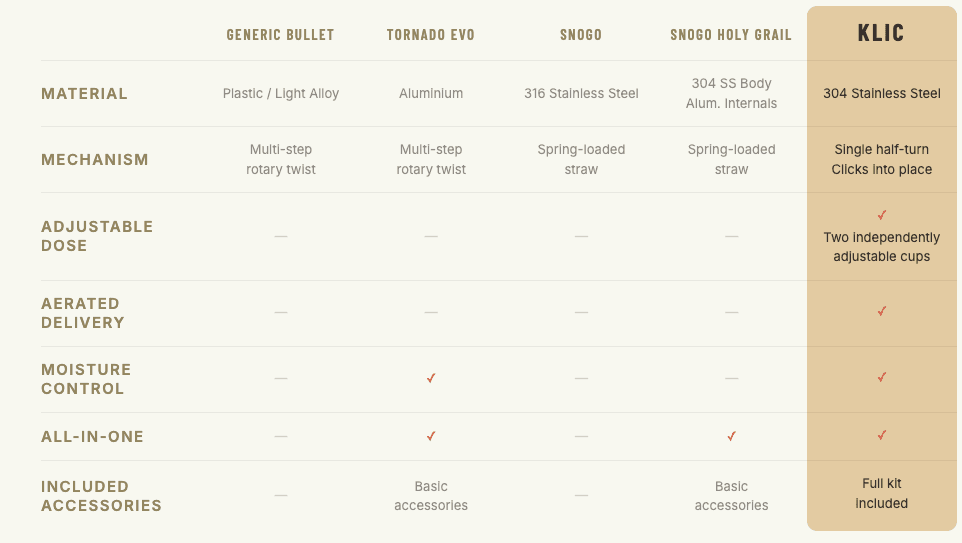
KLIC VS. THE REST
A comparison of powder dosing devices
Generic Snuff Bullets
The standard bullet has been around for decades and remains the most widely used powder dosing tool in the world by volume. It works — in the sense that it dispenses powder. It does not work particularly well.
The mechanism requires multiple awkward steps: twist the device to fill the chamber, invert it, twist halfway, flip it upright, complete the twist. Every use is a minor inconvenience with a real risk of spillage. There is no moisture control, so powder clumps. There is no dose adjustment, so consistency is guesswork. Most are made from lightweight alloys or plastic, and most break, clog, or leak within weeks of regular use.
For occasional, low-stakes use, the cheap bullet is a functional object. For anyone using a powder tool with any regularity, it is a frustrating one.
Best for: Infrequent use, disposable kit, situations where loss or damage is likely. However they are barely superior to improvised solutions.
Tornado EVO
The Tornado EVO is the honest answer to the generic bullet's failures. It takes the same fundamental design and executes it a bit better. Aluminum construction, a larger capacity chamber, and an integrated desiccant that can keep powder dry.
The limitations are structural rather than quality-related. The EVO still requires the same multi-step twist process as a generic bullet — fill, invert, partial twist, upright, complete — and dispenses a small fixed dose with no adjustment for those who want more control. The aluminum construction is lighter and less substantial in the hand than stainless steel. The tool is still prone to many of the issues that plague this design; it can still jam and clog like a regular snuff bullet.
At $90, the Tornado EVO seems overpriced, as it's just a larger, more durable upgrade from a cheap bullet without significant innovation or added features.
Best for: Anyone who's outgrown cheap bullets but isn't ready to think beyond them.
SnoGo
SnoGo built a brand around the bump straw format and became the default name in certain communities. The recognition is real. A form factor and brand refined across multiple generations.
The SnoGo straw operates differently from a bullet — a spring-loaded scoop at the base is pressed against an external powder source to fill, then placed to the nose and inhaled through the straw. It's fast and intuitive, optimized for social contexts where ease of passing matters. But it is not self-contained: you still need to carry your powder separately and load from it each time. Every use means opening the bag, pressing the scoop in, and closing it again; repeated exposure that lets moisture in gradually and leaves you fishing around as the bag empties. Over time the powder clumps, the bag deteriorates, and the process becomes messier.
The other trade-off is control. The spring mechanism delivers an inconsistent dose and isn't adjustable, and the straw format means there's no aeration; powder travels directly from the scoop to the nose piece without the buffering that a chambered delivery system provides. What it is, ultimately, is a social prop that solved a convenience problem: fast to pass, easy to explain, recognizable enough to signal familiarity. It was never designed to be a precision tool or solve every pain point. Accidents and annoyances are common with a straw going into a bag.
Best for: Someone who wants a brand name they can drop in conversation and doesn't need the tool to do more than that.
XZONE StraW / EZ BUMPS / BUMPSKE / OTHERS
XZONE, EZ Bumps, and Bumpske appear to be essentially a lower-cost SnoGo-style straw. Same general spring-loaded scoop format, same external loading workflow, same core trade-offs. It is fast and simple but not self-contained, not adjustable, and not meaningfully different in function. Products that appear this derivative can also carry a degree of uncertainty, which may make long-term support and continuity less dependable than with the more established original brand. They are knock-offs and they behave like them, with more frequent issues and less durability.
The main advantage here is price. If someone wants the SnoGo experience without paying SnoGo pricing, XZONE, EZ Bumps, or Bumpske makes sense, though they may encounter more issues with these lower quality versions, and it's still just a straw. If they are looking for a more advanced or more engineered solution, it doesn’t really change the conversation.
Best for: Buyers who want a cheaper SnoGo style bump straw and aren't concerned about what they're actually getting.
SnoGo Holy Grail
The Holy Grail is SnoGo's answer to the all-in-one question — an integrated storage chamber added to their straw mechanism, eliminating the need to carry powder separately. It's the brand's most ambitious product and, in terms of convenience, a step forward.
The build quality reflects the price in some respects: a stainless steel exterior, a sealed internal channel. Where the Holy Grail makes a compromise is in its internal components, which are aluminium — lighter and less durable than the all-steel exterior suggests. The delivery mechanism remains the same spring-loaded straw format as the standard SnoGo: fast, but fixed dose, and without aeration. It appears that the internal chamber is not straightforward to clean or to fix powder clogging. The same issues with putting a straw in to a bag will arise, but potentially moreso as the chamber isn't flexible like a bag.
At $280, the Holy Grail is the only product in this comparison that costs more than KLIC and delivers less. No adjustable dosing. No aerated delivery. No humidity control. A mixed-material interior that doesn't match the ambition of the exterior. For someone approaching the premium tier fresh, that math doesn't work.
Best for: Committed SnoGo loyalists who want integrated storage and aren't comparison shopping.
KLIC
At $249, KLIC is not just the best value in the premium tier, it is a fundamentally different kind of tool designed from first principles. It's the most considered SnoGo alternative on the market. The patent-pending mechanism sets it apart immediately. Where other devices in this category requires a multi-step process — twist, invert, partial twist, flip, complete — KLIC loads with a single half-turn of the knob. One motion, device upright, done. Detents lock the knob into each dose position with an audible click — there is no guessing whether the cups are aligned, no holding the device at a careful angle and hoping the mechanism holds. It either clicks, or it hasn't. That certainty, repeated across every use, is what precision actually feels like.
Loading is equally considered. The wide sliding door on the chamber was designed to align naturally with the opening of a standard small bag — no funnel required for everyday use, no spilling while trying to pour into a narrow hole. For those who prefer to load from the base, removing the knob opens the full chamber, and the included funnel guides powder in cleanly. Emptying is the reverse: invert with the knob removed, pour directly back into a container or bag. The whole system is designed around the reality that powder needs to go in and come out cleanly, every time, without ceremony or mess.
The same engineering logic extends to maintenance. The sliding door, when open, exposes the entire chamber — a meaningful distinction from bullets and straws where cleaning means attempting to reach a full chamber through a narrow intake hole. KLIC's chamber is fully accessible. The included brush reaches everything. Bullets and spring-loaded straws jam because powder finds its way into parts that weren't designed to be opened; KLIC was designed to come apart, be cleaned, and go back together without resistance. It doesn't clog because it was built with the assumption that it would be used seriously and maintained properly.
Inside that half-turn, one of two independently adjustable dosing cups fill from the main chamber. Inhaling through the top draws an aerated dose — five precision-drilled perforations around the body allow air to enter from beneath, carrying the powder upward and delivering it with a softness and efficiency that no straw or bullet can replicate. The practical difference is immediate: a gentle draw is sufficient where other devices demand a forceful one. Less effort, more consistency, every time. Each cup can be adjusted independently with the included hex tool, giving genuine control over dose size in a way no other device in this class offers. No more costly accidents or mistakes.
The construction is uncompromised. All three parts are precision machined from stainless steel. There are no corners cut in the parts you don't see. Total assembled weight is approximately 150 grams. It is substantial in the hand in a way that immediately communicates that this is not a disposable object.
An integrated desiccant keeps the chamber at controlled low humidity. The included moisture-controlling dry packs are replaceable so your material will stay dry wherever you are. The chamber holds more than enough.
The Complete Kit ships with a carrying case, cleaning brush, adjustment tool, funnel, three dry packs, optional nose tips, and a product box that converts into a stash box.
The experience of using KLIC is different from using anything else in this category — not incrementally, but categorically. It is the kind of object that gets passed around, that warrants questions, that people want to hold. That reaction is not accidental. It is the result of building something properly. It's the best SnoGo alternative.
Best for: Anyone who wants the most precise, most complete, and most considered powder dosing tool available—and intends to keep it.
Conclusion
Every tool in this category does the same thing. What separates them is how well, how consistently, and with how much intention. The generic bullet works until it doesn't. The Tornado EVO works reliably. SnoGo built a culture around a straw and deserves credit for it, but culture isn't engineering, and a straw is still a straw. The Holy Grail is the most expensive option here and the only one that asks you to pay more for less.
KLIC approaches the problem from a different premise entirely: what would this object look like if precision, functionality, and design were treated as non-negotiable? If nothing about how it worked was borrowed from what came before? The result is a tool that outperforms everything in this category on every axis that matters: mechanism, materials, dose control, maintenance, and the simple experience of using it.